
Hepatitis Control Program Pakistan: Free Screening, Vaccination & Treatment Explained
Pakistan carries one of the highest burdens of viral hepatitis in the world, with millions of people living with Hepatitis B or Hepatitis C, often without knowing it. In response, the federal and provincial governments have established dedicated Hepatitis Control Programs aimed at expanding free screening, vaccination, and treatment services across the country. This article explains how Pakistan’s Hepatitis Control Program works, its history, objectives, eligibility for free services, and why continued investment in hepatitis control remains a public health priority.
The Scale of the Hepatitis Problem in Pakistan
According to the World Health Organization (WHO), Pakistan is home to an estimated 13.8 million people infected with Hepatitis B and C combined, making it one of the most heavily affected countries globally. In Punjab alone, health surveys have recorded hepatitis prevalence rates as high as 2% for Hepatitis B and 8.9% for Hepatitis C, based on the 2018 BOS Survey conducted by the provincial health department. These infections, if left undetected and untreated, can progress to chronic liver disease, cirrhosis, and liver cancer — making early detection and treatment critical.
WHO and Pakistan’s Ministry of Health have jointly emphasized that intensifying hepatitis C prevention efforts could avert an estimated 850,000 deaths and 1 million new infections, while also saving the country roughly PKR 3.3 billion over five years through reduced long-term treatment costs — underscoring both the human and economic case for sustained investment in hepatitis control.
Read Also:Pakistan Polio Eradication Campaign 2026 – NEOC Vaccination Drive Guide
History and Structure of Pakistan’s Hepatitis Control Program
Pakistan’s national response to hepatitis dates back to 2005, when the Hepatitis Prevention and Control Program (HPCP) Project Management Unit (PMU) was established at the federal level. Following the 18th Constitutional Amendment, which devolved health as a policy area to the provinces, the program was restructured, and provincial governments took on primary responsibility for implementing hepatitis control services within their respective jurisdictions — while continuing to operate under the broader National Hepatitis Strategic Framework (NHSF).
Punjab’s Hepatitis Prevention and Control Program, launched in 2006, remains one of the most developed provincial models. Its stated vision is to achieve a “Hepatitis-free Punjab with zero deaths caused by complications of hepatitis,” and it operates through secondary healthcare facilities across the province, offering free Hepatitis B vaccination along with Hepatitis B and C serologic testing, treatment, and referral services.
Sindh’s Hepatitis Free Sindh Program, launched under the Chief Minister’s health initiatives, similarly provides free screening and vaccination. The program operates through 48 sentinel sites spread across civil hospitals, DHQs, THQs, rural health centers, and dispensaries throughout Sindh. Each site is staffed with a medical officer, nurse, data processor, laboratory technician, and attendant, and offers free rapid testing (ICT kits), ELISA testing, Hepatitis B vaccination, and treatment including antiviral medications such as Interferon injections and oral tablets like Lamivudine and Adefovir.
Khyber Pakhtunkhwa and Balochistan operate similar provincial hepatitis control programs under their respective health departments, though the scale and infrastructure vary by province.
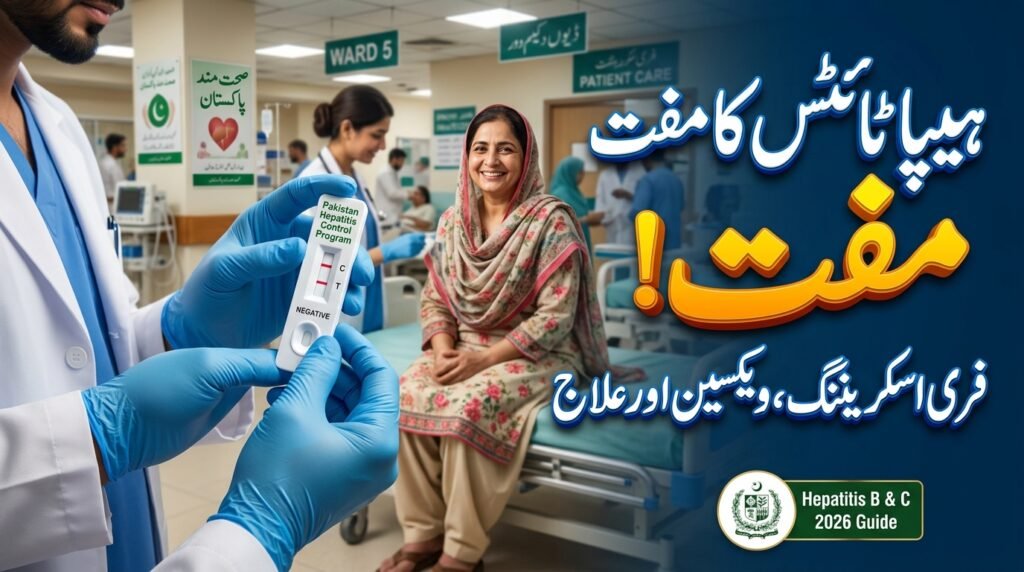
Core Services Offered
Across the various provincial hepatitis control programs, the core services generally include:
- Free Hepatitis B vaccination for both adults and children, with dosage adjusted by age (1ml for adults, 0.5ml for pediatric patients)
- Free screening and diagnostic testing, using rapid ICT test kits and confirmatory ELISA testing
- Viral load testing, using RNA and DNA testing kits for Hepatitis C and B respectively
- Free treatment for confirmed cases, including antiviral medications for chronic Hepatitis B and C
- Referral services for patients requiring more specialized or advanced liver care
- Public awareness campaigns on hepatitis transmission, prevention, and safe medical practices
Program Objectives
The broader objectives of Pakistan’s hepatitis control programs, as outlined by provincial health departments, include:
- Increasing Hepatitis B immunization coverage, particularly in high-risk and high-endemic regions
- Improving hospital waste management, infection control, and injection safety practices in public sector health facilities — since unsafe medical practices remain a major transmission route for hepatitis in Pakistan
- Expanding access to quality diagnostic services for effective case management
- Strengthening surveillance infrastructure at the provincial and district level to track disease burden and treatment outcomes
- Institutionalizing prevention and control interventions across secondary healthcare facilities
Who Is Eligible for Free Hepatitis Services?
Provincial hepatitis control programs generally aim to serve the general public, with particular focus on:
- Individuals in high-risk or high-prevalence districts
- Healthcare workers exposed to blood-borne pathogens
- Newborns and children requiring routine Hepatitis B vaccination
- Patients referred from other public health facilities showing symptoms or risk factors for hepatitis
- Low-income and underprivileged populations who may otherwise be unable to afford private testing or treatment
Screening and initial vaccination services are typically available free of cost at designated government hospitals, sentinel sites, and secondary healthcare facilities, without requiring specific insurance or income documentation in most cases — though this can vary by province and facility.
How to Access Hepatitis Control Program Services
To access free hepatitis screening, vaccination, or treatment through the government program:
- Visit your nearest designated government hospital, DHQ, THQ, or rural health center that hosts a hepatitis sentinel site or program facility
- Request Hepatitis B and C screening — this typically involves a rapid ICT test, with ELISA confirmation for positive results
- If diagnosed positive, patients are referred for further evaluation, including viral load testing, before starting free treatment
- Follow the prescribed treatment and monitoring schedule, which may include periodic follow-up testing to track treatment response
Given that program structures differ between provinces, patients are advised to check with their provincial health department’s official website for the nearest facility offering these services.
Broader National and International Support
Beyond provincial programs, Pakistan’s hepatitis response has also received support from international partners. The World Health Organization has worked closely with Pakistan’s Ministry of Health to intensify hepatitis C prevention strategies, framing it as both a public health necessity and a cost-saving investment for the country’s healthcare system. Non-governmental organizations, such as SHINE Humanity, have also contributed to the broader effort by conducting community-level screening, confirmatory PCR testing, and free treatment for identified hepatitis C patients, alongside preventive Hepatitis B vaccination for those who test negative.
Official Website Link
Why Continued Investment Matters
Hepatitis remains a largely preventable and, in the case of Hepatitis C, curable disease with modern antiviral treatment. However, the scale of Pakistan’s hepatitis burden — driven historically by factors such as unsafe injection practices, inadequate blood screening in some settings, and limited public awareness — means that sustained government investment in screening, vaccination, and treatment infrastructure remains essential. Without continued funding and public engagement, WHO has warned that Pakistan risks missing global targets for hepatitis elimination, with significant human and economic costs.
Conclusion
Pakistan’s Hepatitis Control Program, operating through provincial health departments in Punjab, Sindh, Khyber Pakhtunkhwa, and Balochistan, represents one of the country’s most important public health efforts, offering free screening, vaccination, and treatment services to millions of citizens at risk of Hepatitis B and C. With international support from organizations like WHO and continued provincial investment, the program aims to move Pakistan closer to a future free of hepatitis-related deaths. Citizens are encouraged to get tested at their nearest government health facility, particularly if they fall into a high-risk category, since early detection remains the most effective tool against the long-term complications of viral hepatitis.
Disclaimer
This article is for general informational purposes only, based on publicly available information from provincial health departments and WHO at the time of writing. Hepatitis prevalence data, program services, and eligibility criteria may vary by province and change over time. Readers should consult their provincial health department’s official website or a qualified healthcare provider for accurate, up-to-date information regarding screening, vaccination, and treatment.